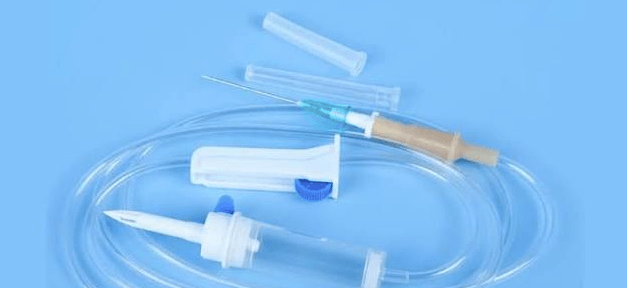
An intravenous administration set looks simple from across the room, just a bag and a tube, but it’s actually a carefully engineered chain of components. Knowing the individual IV set parts helps nursing staff troubleshoot flow problems faster and helps buyers ask the right questions when comparing suppliers.
The Spike and Drip Chamber
The spike punctures the IV bag’s port and creates a sealed path for fluid to travel. Just below it, the drip chamber lets staff visually count drops per minute, which is still one of the simplest ways to estimate flow rate without electronic equipment.
Tubing and Roller Clamp
The tubing carries fluid from the drip chamber to the patient, and its internal diameter partly determines how fast fluid can flow under gravity. The roller clamp slides along the tubing to manually control that flow rate.
Injection Ports
Most sets include one or more injection ports along the tubing, allowing staff to administer additional medications without disconnecting the main line.
Air Vent and Filter
Some sets include an air-eliminating filter to catch small air bubbles before they reach the patient, an important safety feature especially in longer infusions.
Connector at the Patient End
The distal end typically terminates in a Luer lock connector, which attaches securely to the IV catheter hub, preventing accidental disconnection during patient movement.
See also: Beyond Screens: The Invisible Tech Powering Your Daily Life
Additional Resource
A visual walkthrough of iv set parts makes it much easier to identify each component when training new staff or evaluating a new supplier’s set.
Frequently Asked Questions
What happens if air gets into the tubing?
Small amounts of air are generally filtered or trapped in the drip chamber, but larger air pockets should be cleared before the line reaches the patient to avoid complications.
Why does tubing length vary between sets?
Longer tubing offers patients more mobility, while shorter tubing is sometimes preferred in critical care settings for tighter control and reduced dead space.
Can injection ports be reused for multiple medications?
Yes, but each use should follow proper disinfection protocol to avoid introducing contamination into the line.
Conclusion
Every component in an IV administration set serves a specific purpose, from the spike that punctures the bag to the connector that meets the patient. Understanding these parts individually turns a routine setup task into a more confident, error-resistant process.